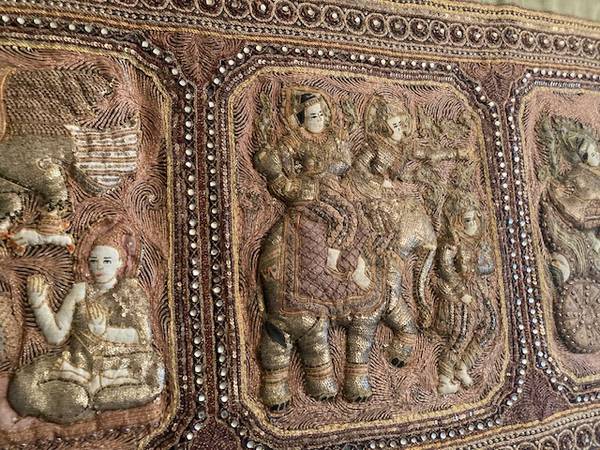
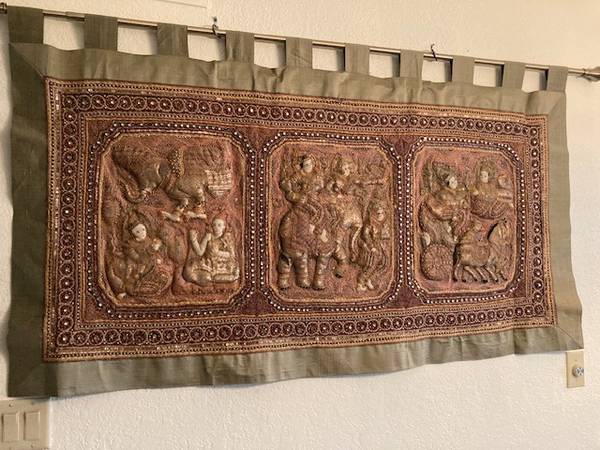
This piece is a traditional Burmese Kalaga (also known as shwe chi doe, meaning "gold thread embroidery"). These are heavily embroidered appliqué tapestries known for their 3D relief, which is created by stuffing the figures with cotton or straw.
History & Origin
• Cultural Roots: The art form originated in the mid-19th century during the Konbaung Dynasty (the last dynasty of Myanmar). It reached its height in the royal court of Mandalay.
• Purpose: Originally, Kalagas were used as palace decorations, room partitions, temple hangings, or coffin covers for high-ranking monks.
• The Scenes: Your piece features three distinct panels:
◦ The Elephant Rider: Likely depicts a royal figure or a scene from the Ramayana or Jataka tales (stories of the Buddha's past lives).
◦ The Mythical Bird (Hinsa/Hamsa): The central-top figure in one panel is a mythological swan-like creature, a common symbol of purity and wisdom in Burmese culture.
◦ The Chariot: Shows a celestial being or deity being pulled by horses, often representing a transition between realms or a royal procession.
Technique & Materials
This is a labor-intensive craft. The figures are hand-stitched onto a background (usually velvet or linen) using:
• Metallic Threads: For the intricate swirling patterns.
• Sequins & Beads: Used to provide the "shimmering" effect that earns them the name "golden tapestries."
• Glass "Stones": Small glass or mirror inserts (as seen in the borders) to catch the light.
From AI:
Observation on Your Piece: Based on the style and the use of the green linen header for hanging, this appears to be a vintage mid-20th-century piece (likely 1950s–1980s). It is in good visual condition. For a valance of this size and detail, a fair market value would typically range between $350 and $650, depending on the buyer and the venue (e.g., an estate auction vs. a specialized gallery).